Menu
Map

Map
Menu

Many people are unaware that over the years the Church of Jesus Christ of Latter-day Saints (Mormon Church) has made thousands of changes to its scriptures. LDS leaders have added and deleted words and tampered with previously published revelations by writing in new material and falsely attributing it to an earlier date. What follows are examples of some of the most significant revisions made to the Book of Mormon, the Doctrine and Covenants, and the Pearl of Great Price. Within this article are links to scanned images of these historical documents from the 1830s.
Changes to the Book of Mormon
According to the Mormon Church’s teaching manual, Gospel Principles,page 53,
Joseph Smith translated the Book of Mormon into English through the gift and power of God. He said that it is "the most correct of any book on earth, and the keystone of our religion, and a man would get nearer to God by abiding by its precepts, than by any other book" (History of the Church, 4:461).
Yet, the book which Joseph Smith declared was "the most correct of any book on earth" (History of the Church, vol. 4, p. 461) has been revised in over 3900 places. Most of these changes were made to correct embarrassing spelling and grammatical errors (this will be examined in more detail later in this article). However, there are numerous other changes which affect the doctrinal teachings of the Book of Mormon.
Changes in Doctrine. Key Passages on Deity in the original 1830 text of the Book of Mormon were changed in the 1837 edition to reflect Joseph Smith’s changing doctrine of Deity. Joseph originally taught that Jesus and the Father were the same person and that God had always been God, but later developed the idea that the Father and Son were separate Gods, each with a tangible body. Smith taught that both God the Father and Jesus had been mortal men. What follows are specific examples from the original 1830 first edition Book of Mormon (which did not have verse divisions) compared with the altered text of recent versions.
|
Original 1830 Text |
Current, Altered Text |
|
1 Nephi 3, p. 25* — And he said unto me, Behold, the virgin whom thou seest is the mother of God, after the manner of the flesh [View the 1830 Book of Mormon text.] *The 1830 text did not have verse divisions. |
1 Nephi 11:18 — And he said unto me, Behold, the virgin whom thou seest is the mother of the Son of God. |
|
1 Nephi 3, p. 25 — And the angel said unto me, behold the Lamb of God, even the Eternal Father! |
1 Nephi 11:21 — And the angel said unto me, behold the Lamb of God, even the Son of the Eternal Father! |
|
1 Nephi 3, p. 26 — And I looked and beheld the Lamb of God, that he was taken by the people; yea, the Everlasting God, was judged of the world. |
1 Nephi 11:32 — And I looked and beheld the Lamb of God, that he was taken by the people; yea, the Son of the Everlasting God, was judged of the world. |
|
1 Nephi 3, p. 32 — These last records ... shall make known to all kindreds, tongues, and people, that the Lamb of God is the Eternal Father and the Savior of the world. |
1 Nephi 13:40 — These last records ... shall make known to all kindreds, tongues, and people, that the Lamb of God is the Sonof the Eternal Father and the Savior of the world. |
Other Changes to the Book of Mormon. A variety of other changes have been made that also alter the meaning of the text.
|
Original 1830 Text |
Current, Altered Text |
|
Alma 15, p. 303 — yea, decreeth unto them decrees which are unalterable, according to their wills. |
Alma 29:4 — Yea, I know that he alloteth unto men, yea, decreeth unto them decrees which are unalterable, according to their wills. |
|
Note: Later editions from at least 1840 to 1980 deleted without explanation these eight words. LDS leaders re-inserted the omitted words into all editions since 1981.
|
|
|
Mosiah 9, p. 200 — … King Benjamin had a gift from God, whereby he could interpret such engravings … |
Mosiah 21:28 — … King Mosiah had a gift from God, whereby he could interpret such engravings … |
|
Ether 1, p. 546 — … and for this cause did King Benjamin keep them … |
Ether 4:1 — King Mosiah keep them … Note: According to Book of Mormon chronology, King Benjamin was already dead when these events took place. Apparently LDS leaders changed the name to Mosiah to eliminate the mistake. |
|
2 Nephi 8, p. 87boweth down, and the great man humbleth himself not ... |
2 Nephi 12:9 — … and the mean man boweth not down, and the great man humbleth himself not … |
|
1 Nephi 5, p. 52 — … O house of Jacob, which are called out of the waters of Judah, which swear by the name of the Lord … |
1 Nephi 20:1 — … O house of Jacob, which are called out of the waters of Judah, or out of the waters of baptism, which swear by the name of the Lord … |
|
2 Nephi 12, p. 117 — … and many generations shall not pass away among them, save they shall be a white and a delightsome people. |
2 Nephi 30:6 (1840 edition) — … and many generations shall not pass away among them, save they shall be a white pure and a delightsome people. (Later editions until 1981) … white and delightsome (1981 to current edition) pure and delightsome |
| Note: Before 1978 dark-skinned males were not allowed to hold positions of priesthood authority within the Mormon church. Today Mormon scriptures continue to teach that dark skin is a curse from God and a sign of His displeasure (See 1 Nephi 12:23; 2 Nephi 5:21; Alma 3:6). Brigham Young, second president and prophet of the LDS church referred to those with dark skin as being "cursed with a s[k]in of blackness" (Journal of Discourses, vol. 11, p. 272). | |
Grammatical, Spelling and Syntactical Changes. As stated earlier, the Mormon church has made many changes to the Book of Mormon in order to correct Joseph’s poor grammar and spelling. This should not have been necessary, however, given the manner in which Joseph is supposed to have produced this book. According to eyewitness testimony, Joseph Smith gave his scribe a word-for-word dictation of what he read off a magical stone that he had placed in his hat. (This seer stone would later be referred to by the Old Testament name of Urim and Thummim.) The fact that Joseph simply dictated the words he read on the stone was supposed to prove that the Book of Mormon came from God and not Joseph. This view was taught by Joseph F. Smith, 6th President of the Mormon church. On Saturday, February 25, 1881, Oliver B. Huntington recorded in his journal:
I went to Provo to a quarterly Stake Conference. Heard Joseph F. Smith describe the manner of translating the Book of Mormon by Joseph Smith the Prophet and Seer, which was as follows as near as I can recollect the substance of his description. Joseph did not render the writing on the gold plates into the English language in his own style of language as many people believe. But every word and every letter was given him by the gift and power of God. So it is the work of God and not of Joseph Smith, and it was done in this way … The Lord caused each word spelled as it is in the book to appear on the stones in short sentences or words, and when Joseph had uttered the sentence or word before him and the scribe had written it properly, that sentence would disappear and another appear. And if there was a word wrongly written or even a letter incorrect the writing on the stone would remain there. (Journal of Oliver B. Huntington, p. 168 of typed copy at the Utah State Historical Society)
For more details on this subject and quotes from the eyewitnesses, see the article, Translation or Clairvoyance.1
While the following short sampling of changes do not affect the meaning of the text, they do reveal the human origin of the book..
Improper use of "was" in 1830 edition later changed to "were"
"… Adam and Eve, which was our first parents …" [p. 15]
"… the bands which was upon my wrists …" [p. 49]
"… the priests was not to depend …" [p. 193]
"… they was angry with me …" [p. 248]
"… there was no wild beasts …" [p. 460]
Improper use of "is" in the 1830 edition later changed to "are"
"… the words which is expedient …" [p. 67]
"… But great is the promises of the Lord …" [p. 85]
"… And whoredoms is an abomination …" [p. 127]
"… here is our weapons of war …" [p. 346]
Improper use of "a" in the 1830 edition later deleted from text
"… As I was a journeying …" [p. 249]
"… he found Muloki a preaching …" [p. 284]
"… had been a preparing the minds …" [p. 358]
"… Moroni was a coming against them [p. 403]
Improper or slang word usage in 1830 edition deleted, correct words inserted in later editions
"Behold the Scriptures are before you; if ye will arrest them, it shall be to your own destruction." [p. 260] The word "arrest" is now changed to "wrest" [Alma 13:20].
"… they were exceeding fraid …" [pp. 354, 392, 415]. The phrase "exceeding fraid" is now changed to "exceedingly afraid" [Alma 47:2; 58:24; Helaman 4:3].
"… my soul was wrecked with eternal torment …" [p. 214]. The word "wrecked" is now changed to "racked" [Mosiah 27:29].
Changes to the Doctrine & Covenants
The Mormon scripture called the Doctrine and Covenants is a series of revelations which Joseph Smith and other LDS prophets claimed to receive directly from God. The first of these revelations were printed in The Book of Commandments in the year 1833. Since that time many of these revelations have been radically altered, with words and even whole sentences deleted. In other places later doctrinal innovations were written back into earlier revelations to hide the glaring contradictions that would otherwise result. In this way, events that were previously unheard of suddenly become part of the historical record as a revelation from God.
Here are some specific examples representative of thousands of changes:
| Original 1833 Book of Commandments | Current, Altered Doctrine & Covenants |
|
BC 4:2, p. 10 — and he has a gift to translate the book [of Mormon], and I have commanded him that he shall pretend to no other gift, for I will grant him no other gift. [Harmony, Pennsylvania March 1829] |
D&C 5:4 — And you have a gift to translate the plates; [and this is the first gift that I bestowed upon you;] and I have commanded that you should pretend to no other gift [until my purpose is fulfilled in this;] for I will grant unto you no other gift [until it is finished]. Note: The changes to this revelation were necessary for Joseph had already claimed the divine ability to do his own translation of the Bible. Later he would claim the gift to translate ancient Egyptian papyri. However, the evidence does not support these as authentic translations.2 |
|
BC 28:6-7, p. 60 — Behold this is wisdom in me, wherefore marvel not, for the hour cometh that I will drink of the fruit of the vine with you, on the earth, and with all those whom my Father hath given me out of the world: [Harmony, Pennsylvania September 4, 1830] |
D&C 27:5ff — Behold this is wisdom in me, wherefore marvel not, for the hour cometh that I will drink of the fruit of the vine with you, on the earth, and with [Moroni, whom I have sent unto you to reveal the Book of Mormon, containing the fulness of the everlasting gospel…] [Harmony, Pennsylvania first part August 1830, remainder September 1830] Note: At this point in the revelation over 300 words are added regarding the restoration of the Mormon priesthood by means of divine ordination. By making the account part of a revelation that is dated to 1830, it appears the story has been known since then. However, it is not a part of any revelation until the 1835 edition of the Doctrine & Covenants (section L (50) v. 2, p. 180). Apparently Joseph Smith and Oliver Cowdery, who were in charge of editing the 1835 D&C, inserted this material so that the concept of the Aaronic and Melchizedek priesthoods being restored and the office of high priest would appear to have been in place from the start and would appear to have been given directly by God. The revelation concludes with over 130 additional words, taken from the Bible copied almost verbatim from Ephesians 6:13-17. No explanation is given for the dating discrepancy. |
|
BC 44:26, p. 92 — If thou lovest me thou shalt serve me and keep all my commandments; and behold, thou shalt consecrate all thy properties, that which thou hast unto me, with a covenant and a deed which can not be broken; and they shall be laid before the bishop of my church, and two of the elders, such as he shall appoint and set apart for that purpose. [Kirtland, Ohio February 1831] |
D&C 42:29-30 — If thou lovest me thou shalt serve me and keep all my commandments; and behold, [thou wilt remember the poor, and] thou shaltconsecrate [of] all thy properties [for their support] that which thou hast [to impart] unto me [them] with a covenant and a deed which can not be broken. [And inasmuch as ye impart of your substance unto the poor, ye will do it unto me] and they shall be laid before the bishop of my church [and his counselors], two of the elders [or high priests], such as he shall appoint [or has appointed] and set apart for that purpose. (February 1831) |
| Note: By 1835 when the D&C was printed Joseph Smith had given up on the idea of communalism. Therefore this revelation was changed so that Mormons were no longer told by God to consecrate all their properties, but instead the emphasis is shifted to a command to remember the poor and give "of your property". Also, at the time the revelation was originally given there was no office of "counselor" or "high priest" in the Mormon church, so these also had to be added to the revelation retroactively, once again giving the appearance these offices were there from the beginning. | |
| BC 9:1, p. 22 — Now, behold I say unto you, that because you delivered up so many writings, which you had power to translate, into the hands of a wicked man, you have lost them, and you also lost your gift at the same time … [Harmony, Pennsylvania May 1829] [View Book of Commandments text.] |
D&C 10:1 9:1 — Now, behold I say unto you, that because you delivered up so many [those] writings, which you had power [given unto you] to translate [by the means of the Urim and Thummim], into the hands of a wicked man, you have lost them. (v.2) And you also lost your gift at the same time, [and your mind became darkened]. Note: There is no mention of the Old Testament Urim and Thummim in the Book of Mormon nor is there any connection of the Urim and Thummim to the translation of the Book of Mormon until 1833, which is four years after this revelation was supposedly given. |
| Another example of a revelation that has undergone hundreds of changes was first published in The Evening & Morning Star in October 1832. The revelation was said to have been received in November of 1831. | This revelation is now D&C 68 and contains multiple references to the Melchizedek priesthood, high priests and the First Presidency. Once again the attempt is made to write later developments into previously given revelations to make them fit Joseph’s evolving church structure. |
Changes in the Pearl of Great Price
As with the Doctrine and Covenants, LDS leaders have altered the revelations contained in the Pearl of Great Price.
| Original 1851 Pearl of Great Price |
Current, Altered Pearl of Great Price |
| PGP Moses, p. 14 — And the woman said, The serpent beguiled me, and I did eat. And again, the Lord said unto the woman, I will greatly multiply your sorrow, and your conception. |
PGP Moses 4:19-22 — And the woman said, The serpent beguiled me, and I did eat. And again, [I] the Lord [God] said unto the [serpent: Because thou has done this thou shalt be cursed above all cattle, and above every beast of the field; upon they belly shalt thou go, and dust shalt thou eat all the days of thy life; And I will put enmity between thee and the woman, between thy seed and her seed; and he shall bruise thy head, and thou shalt bruise his heel. Unto the] woman, [I the Lord God said], I will greatly multiply [thy] your sorrow, and [thy] your conception. |
|
PGP Moses, p. 16 — And the Lord said unto Cain, why are you angry? Why is your countenance fallen? If you do well, will you not be accepted? And if you do not well, sin lies at the door, and Satan desires to have you; and except you shall hearken unto my commandments, I will deliver you up, and it shall be unto you according to his desire. |
PGP Moses 5:22-31 — And the Lord said unto Cain, why are you angry [art thou wroth]? Why is your [thy] countenance fallen? If you do [thou doest] well, will you not be [thou shall be] [thou shall be] accepted?. And if you [thou] do[est] not well, sin lie[th] at the door, and Satan desire[th] to have you [thee]; and except you [thou] shall hearken unto my commandments, I will deliver you [thee] up, and it shall be unto you [thee] according to his desire. [And thou shalt rule over him; For from this time forth thou shalt be the father of his lies; thou shalt be called Perdition; for thou wast also before the world. For from this time forth thou shalt be ...] Note: At this point there are an additional 200 words added to this passage including Cain making a pact directly with Satan to be able to kill his brother Abel. |
| PGP JS History, p. 41 — He called me by name and said unto me, that he was a messenger sent from the presence of God to me, and that his name was Nephi. | PGP JS History, 1:33 — He called me by name and said unto me, that he was a messenger sent from the presence of God to me, and that his name was Moroni. |
| Note: All evidence indicates this change was made after the death of Joseph Smith, and cannot be considered a clerical error. Both the handwritten manuscripts for the History of the Church, and the printed history in the Church newspaper Times and Seasons (of which Joseph Smith was editor) give the visiting personage’s name as "Nephi." | |
Conclusion
The historical record is clear. Joseph Smith and subsequent LDS leaders have made thousands of changes to Mormon scriptures without documenting or indicating those changes. This raises the following questions:
Free Book Offer
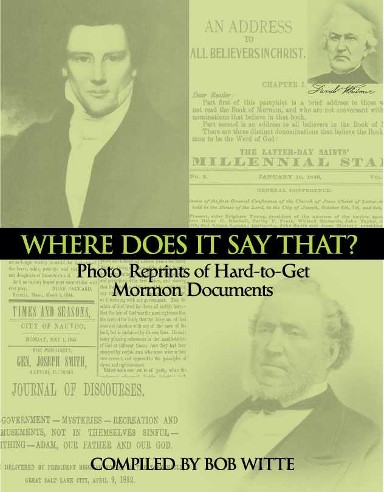
For a limited time the publisher is offering, to members of the LDS Church, a free copy of the research tool titled Where Does It Say That? It provides photographic duplications of key LDS sources that are often difficult to obtain. These sources document the LDS church’s teaching on various issues including: Adam-God, polygamy, the First Vision, and blood atonement. Click here to order.
Notes
1. Later Mormon leaders including General Authority Brigham H. Roberts, expressed a strong desire to abandon the idea that Joseph received the text of the Book of Mormon directly from God. Elder Roberts reasoned that such a view made God responsible for the grammatical and spelling errors and would hinder people from accepting Joseph Smith and the Book of Mormon as divinely inspired. Roberts wrote:
That old theory cannot be successfully maintained; that is the Urim and Thummim did the translating, the Prophet, nothing beyond repeating what he saw reflected in that instrument; that God directly or indirectly is responsible for the verbal and grammatical errors of translation. To advance such a theory before intelligent and educated people is to unnecessarily invite ridicule, and make of those who advocate it candidates for contempt. …
It is no use resisting the matter. The old theory must be abandoned. It could only come into existence and remain so long and now be clung to by some so tenaciously because our fathers and our people in the past and now were and are uncritical" (B.H. Roberts, Defense of the Faith, pp. 306-308).
The new theory proposed by Roberts, and still popular today, is that God only gave Joseph the ideas and concepts for the Book of Mormon. These Joseph recorded in his own grammatically poor language and style. With this new theory, LDS leaders justified themselves in making thousands of word changes designed to enhance the quality and credibility of the Book of Mormon.
A serious problem with the theory of Joseph receiving only inspired ideas and concepts and then rendering them into his own words after much study and contemplation, is that there is no historical evidence to support it. It is a theory born of necessity in the minds of LDS leaders decades after the fact. Compare this with the word-for-word dictation method which has extensive testimony from those who were closest to Joseph personally and present during the act of dictating the Book of Mormon.
Today the Mormon Church gives potential converts a copy of a corrected and grammatically sanitized Book of Mormon but still points to Joseph Smith’s lack of education as evidence for its divine origin. What is implied is that Joseph could not have produced such a book without divine aid. What they do not say is that Joseph’s poor grammar, so evident in the first edition, is now masked by thousands of changes and corrections made by later LDS leaders. As a result, today we do not have the Book of Mormon as it came from the hand of Joseph Smith, but rather a heavily edited version as it has come through the hands of LDS church leaders.
2. Click here for further information on Smith’s failed attempt at translating Egyptian. For details on Joseph’s false revisions to the King James Bible see, Joseph Smith’s "Inspired" Revisions to the King James Bible.